Vehicle Protection. Simplified.
Compare Plans. Save Money. Drive Confidently.
Trusted Providers
Compare extended car warranty options from the industry's most reputable providers in one place.









Why Choose WarrantyPilot
Find the perfect vehicle service contract with our transparent, customer-focused approach.
No robocalls
We never call you. But, we're a phone call away with support when you need it.
No sales pressure
100% online digital experience. Browse and buy at your own pace without any sales calls.
No unfair treatment
Our transparent platform shows the same prices to everyone. No haggling.
No hidden fees
All costs are clearly displayed online. What you see is exactly what you pay, guaranteed.
How It Works
Three simple steps to find your ideal car protection plan.
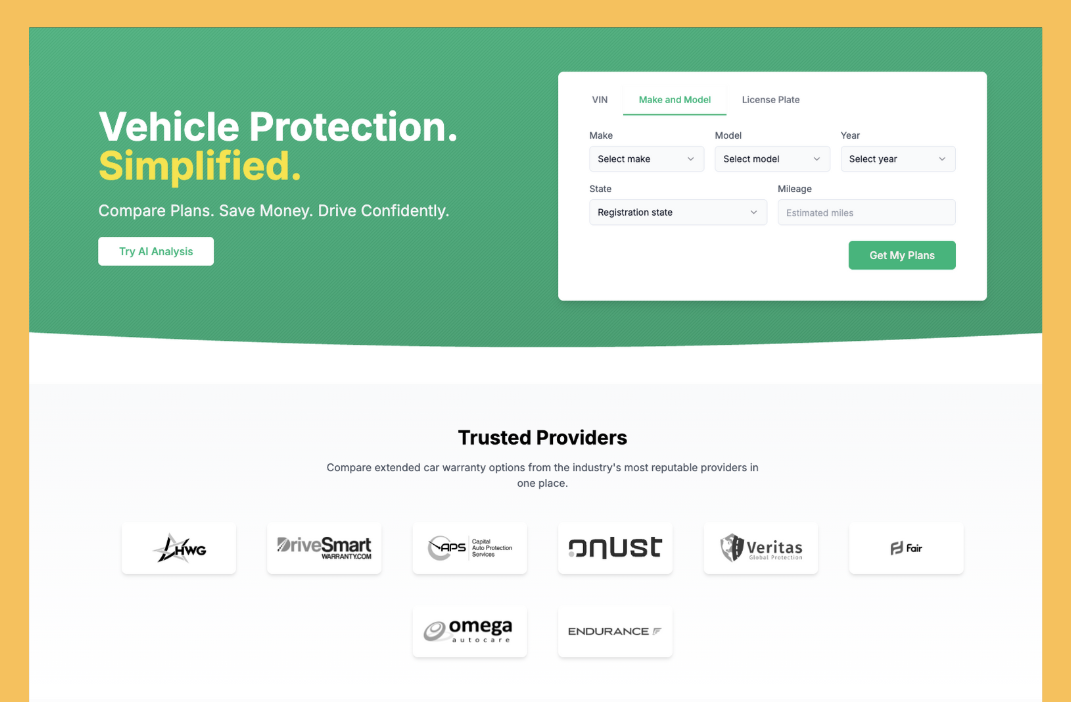
Step 1
Enter Your Vehicle Info
Simply input your vehicle details using your VIN, license plate, or make and model to start your auto warranty comparison.
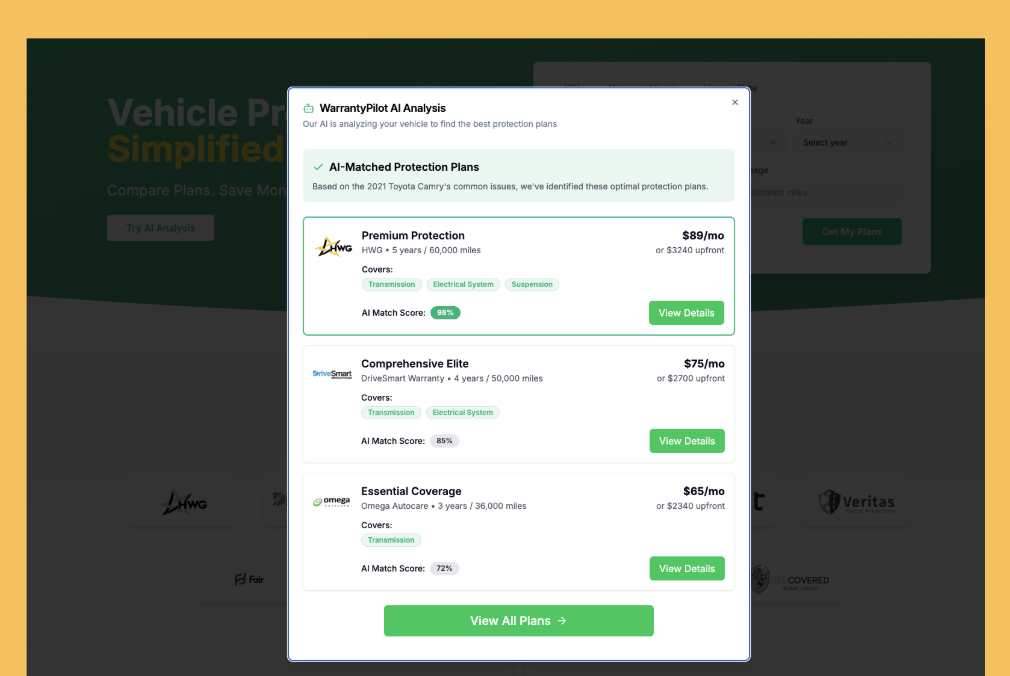
Step 2
Compare Car Protection Plans
Browse and compare vehicle service contracts side by side, with clear coverage details and pricing.
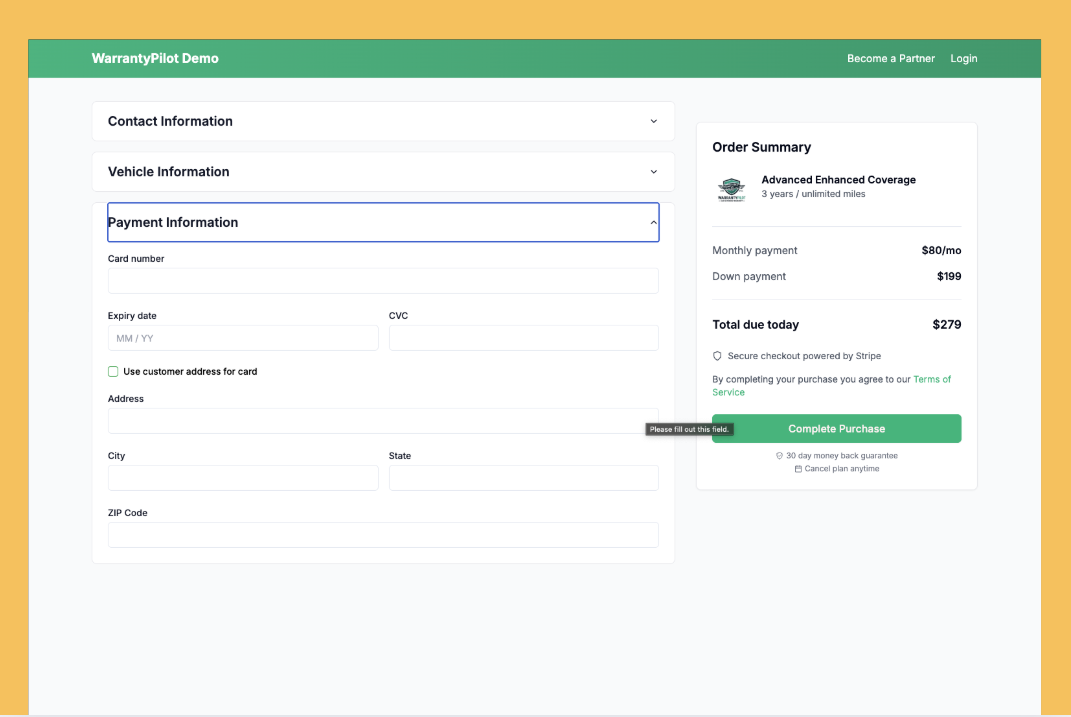
Step 3
Get Extended Auto Protection
Choose your car repair insurance plan, complete your purchase securely, and get instant coverage for your vehicle.
Smart drivers get covered
A vehicle service contract covers what insurance does not.
Car Repair Invoice
Billed to
Riley Jones
123 First St.
Invoice #
#AB2324-01
Without Coverage:
Unexpected Repair Costs
A sudden transmission failure could leave you with a repair bill of $2,500 or more—money you weren't planning to spend.
No Protection Against Inflation
The cost of parts and labor is rising every year. Without a VSC, you're paying future repair costs at tomorrow's higher prices.
Stress and Inconvenience
Driving without protection can lead to unexpected costs and significant stress.
What Our Customers Say

Sarah Johnson
WarrantyPilot made finding the right coverage for my car so easy. I saved money and got better protection!

Michael Chen
I was skeptical at first, but WarrantyPilot really delivered. The process was smooth and I found a great plan.

Emily Rodriguez
The comparison tool is fantastic. It helped me understand my options and choose the best plan for my needs.

Ready to find the perfect extended car warranty?
Compare vehicle service contracts and car protection plans tailored to your needs.

Our Mission
I built WarrantyPilot because I was frustrated with the lack of transparency in the extended warranty industry. Too many people were paying too much for coverage they didn't understand. Our mission is simple: make vehicle protection transparent, affordable, and accessible to everyone.
Gabriel Pendleton
Co-Founder & CEO
Our Technology
When we set out to build WarrantyPilot, I was determined to make technology the great equalizer for car owners. We've built a platform where pricing is upfront, coverage is easy to understand, and comparing your options takes seconds, not days of phone calls. Every feature we ship is designed to put you in control of protecting your vehicle.
Shawn Freeman
Co-Founder & CTO

30 Day Money Back
Try our service risk-free. If you're not completely satisfied, get a full refund within 30 days of purchase.
Unmatched Pricing
We'll match or beat any competitor's price for the same coverage. Our commitment to value is unparalleled.
Save $2,500 or more
Our customers save an average of $2000+ compared to dealer prices. Maximum protection at minimum cost.
Expert advice and insights about vehicle protection


What Documents Do You Need to File a Vehicle Warranty Claim?
When your car breaks down, a vehicle service contract can help cover the repair, but the claim process goes much more smoothly when you have the right paperwork ready. Missing or incomplete documentation is one of the most common reasons claims get delayed or denied. This practical guide walks through the documents you will typically need and the steps that go with them.
Your Contract and Vehicle Identification
Start with the basics that identify you, your coverage, and your vehicle:
- Your vehicle service contract: The contract number and a copy of the agreement so you and the shop know what is covered.
- VIN: Your vehicle identification number, which ties the claim to the right vehicle.
- Current mileage: The odometer reading at the time of the breakdown, which administrators use to confirm the vehicle is within coverage limits.
The Repair Order and Diagnostic Report
The repair facility produces the documents that explain what is wrong and what it will take to fix it. These are central to any claim:
- Diagnostic report: The shop’s findings on what failed and why. Administrators rely on this to determine whether the failure is covered.
- Repair order or estimate: An itemized breakdown of the parts and labor needed for the repair.
The more specific and complete this documentation is, the easier it is for the administrator to approve the claim quickly.
Maintenance Records and Receipts
This is the documentation drivers most often overlook, and it can make or break a claim. Most contracts require you to keep up with the manufacturer’s recommended maintenance, and you may be asked to prove it. Be ready with:
- Oil change receipts
- Records of fluid services, filter changes, and scheduled maintenance
- Dates and mileage for each service performed
- Documentation of any do-it-yourself maintenance, including receipts for parts and fluids
If a component fails and you cannot show it was properly maintained, the administrator may argue that neglect caused the breakdown. Organized records protect you.
The Claim Authorization Step
Documentation is only part of the process. Most contracts require the administrator to authorize the repair before work begins. The typical sequence looks like this:
- Take the vehicle to a licensed repair facility that meets your contract’s requirements.
- Have the shop diagnose the problem and prepare the repair order.
- Contact the administrator, or have the shop contact them, to open the claim and request authorization.
- Wait for approval before the repair work begins.
- Pay your deductible, if one applies, when the covered repair is completed.
Starting repairs before authorization is a common mistake that can lead to a denial, even on a covered failure. When in doubt, get approval in writing first.
A Quick Pre-Claim Checklist
- Contract number and a copy of your agreement
- VIN and current mileage
- Diagnostic report from the repair facility
- Itemized repair order or estimate
- Maintenance records and receipts
- Administrator’s authorization before repairs start
Start With Coverage You Understand
The smoothest claims start long before the breakdown, with a contract you actually understand and records you have kept all along. WarrantyPilot lets you compare vehicle service contracts side by side, so you can review the claims procedure, covered components, and requirements clearly before you buy, with transparent pricing and no high-pressure sales.
Keep your paperwork organized, follow the authorization steps, and your claim has the best possible chance of a fast, smooth approval.

Dealership Extended Warranty vs. Buying Online: What Drivers Should Compare
When you buy a car, the dealership will often offer an extended warranty right there in the finance office. It is convenient, but it is not your only option. You can also compare and buy coverage online, frequently with more choice and more transparency. Before you decide, here is what to compare between the two approaches.
The Buying Experience
At the dealership, coverage is usually presented during the finance paperwork, a moment when you are already making a big decision and may feel pressure to add it quickly. Buying online flips that dynamic. You can research at your own pace, read the full contract, and compare options without anyone pushing you to decide on the spot.
Pricing and Markup
Dealership plans can carry added markup, and the price is often negotiable, which means two buyers can pay very different amounts for similar coverage. There is also a hidden cost to watch for: if you roll the warranty into your auto loan, you may end up paying interest on the coverage for the life of the loan. Buying online typically means upfront pricing you can compare directly, without financing the cost over years of interest.
Provider and Plan Choice
- Dealership: Often offers a single plan tied to the brand or one administrator, with limited room to compare alternatives.
- Online: Lets you compare multiple providers and coverage levels, and choose the deductible, term, and add-ons that fit your needs.
Repair Flexibility
Some dealer-backed coverage requires you to return to the dealership for service. Many third-party vehicle service contracts let you use any licensed repair facility, which can be more convenient if you already have a mechanic you trust. Always check the repair facility rules before you buy, regardless of where you purchase.
Transparency
One of the biggest advantages of buying online is the ability to see everything clearly before you commit, the price, the covered components, the exclusions, the deductible, and the terms. When you can review the fine print without time pressure, it is much easier to make a confident, informed decision.
What to Compare Before You Buy
- Total price and whether it would be financed into a loan
- Covered components and exclusions for the coverage tier
- Deductible amount and whether it is per visit or per repair
- Where you can get repairs done and whether pre-authorization is required
- Cancellation and transfer terms
- Provider reputation and customer reviews
Which Is Right for You?
The dealership can be convenient, and for some brand-loyal buyers it works well. But if you want to compare prices, choose from more providers, avoid financing the cost over years of interest, and review the contract on your own time, buying online has clear advantages. The most important thing is to compare like with like, the same coverage level and terms, before you decide.
Compare Online With WarrantyPilot
WarrantyPilot was built to make this comparison simple. Instead of accepting a single dealership offer, you can review multiple vehicle service contracts side by side, with transparent pricing, clear terms, and no high-pressure sales tactics, so you can choose coverage that genuinely fits your vehicle and budget.
Before you say yes in the finance office, it is worth a few minutes to see what the same coverage looks like online.

Best Extended Warranty Coverage for High-Mileage Cars: What to Look For
If your odometer has crossed 80,000, 100,000, or even 120,000 miles, you might assume an extended warranty is off the table. The good news is that coverage is usually still available for high-mileage vehicles. There may be fewer options as mileage climbs, and pricing tends to be higher, but a well-chosen plan can still protect you from the expensive repairs that become more likely as a car ages.
Here is what to look for when comparing coverage for a high-mileage car.
Is Coverage Even Available at High Mileage?
Yes. Many providers offer plans for vehicles well beyond 100,000 miles, and some extend coverage up to 150,000, 200,000, or even higher depending on the vehicle and provider. The key is that high mileage is not a hard cutoff, it simply narrows your choices and affects price. The earlier you shop, the more options you tend to have, so it is worth comparing now rather than waiting another 20,000 miles.
Why High-Mileage Cars Need a Closer Look
Around the 100,000-mile mark, wear-related failures become more common. Engines, transmissions, suspension components, cooling systems, and electrical parts are all more likely to need attention. Because these repairs can run from several hundred to several thousand dollars, this is exactly the stage where coverage can deliver the most value, if the plan fits your vehicle.
Which Coverage Tier Fits a High-Mileage Car?
Powertrain
The most affordable tier, focused on the engine, transmission, and drive components. This is often a practical choice for older, higher-mileage cars where the main concern is protection against the most expensive mechanical failures.
Powertrain Plus
A balanced middle tier that adds systems such as electrical, cooling, steering, or air conditioning. For many high-mileage drivers, this is the sweet spot between cost and coverage.
Bumper-to-Bumper
The most comprehensive tier. It may be available on some higher-mileage vehicles, though availability narrows and cost rises as mileage increases. Worth comparing if you want the broadest protection.
What to Look For When You Compare
- Mileage eligibility: Confirm the plan accepts your current mileage and how long coverage lasts.
- Covered components vs. exclusions: Make sure the systems most likely to fail on your vehicle are actually covered.
- Deductible structure: Check whether it applies per visit or per repair.
- Maintenance requirements: High-mileage coverage almost always depends on keeping up with scheduled maintenance.
- Added benefits: Roadside assistance, towing, and rental reimbursement can be especially useful on an older car.
- Provider reputation: Review the administrator’s claims process and customer reviews before buying.
Maintenance Is Non-Negotiable
On a high-mileage vehicle, staying current with oil changes, fluid services, and scheduled maintenance is not just good practice, it is often required to keep your coverage valid. Keep your receipts and service records organized. If a component fails and you cannot show it was properly maintained, a claim can be denied.
Is It Worth It?
The answer depends on your vehicle, how long you plan to keep it, and whether a sudden repair bill would create financial stress. If a $2,000 to $4,000 transmission or engine repair would be hard to absorb, comparing coverage for your high-mileage car is well worth a few minutes.
Compare High-Mileage Plans With WarrantyPilot
WarrantyPilot makes it easy to see which providers cover your vehicle at its current mileage and how their plans compare on price, coverage, and benefits. Instead of guessing whether your car still qualifies, you can review real options side by side, with no pressure and no hidden fees.
A six-digit odometer does not mean the end of the road. With the right plan, you can keep driving your car with more confidence and less worry about what might break next.
Frequently Asked Questions
Get answers to common questions about extended car warranties and auto protection plans.